
+A Robot Project Data Analysis Documentation
Version: 0.5.0
Edit Time: November 4, 2025
1. Project Background and Content
Business Scenario
The +A Robot Project focuses on the core warehouse sorting scenario (T-sort). Its core business is to realize the full-process automated operations of goods receiving, sorting, and chute discharging via AGV robots (commonly known as “Little Yellow Robots”), serving business lines requiring high-frequency sorting such as e-commerce warehousing and retail supply chains. With the growth of business volume, the traditional operation model has gradually exposed four core pain points:
- Unclear efficiency bottlenecks: The entire sorting process (task creation → robot scheduling → sorting execution → task closure) lacks quantitative monitoring. Only “overall slowness” can be perceived, and specific bottlenecks (e.g., robot scheduling delays, excessive chute load) cannot be identified.
- Blind resource allocation: The number of AGV robots is configured based on experience. During peak hours, task backlogs often occur due to insufficient robots; during off-peak hours, resource waste is caused by robot idleness. There is a lack of a scientific prediction model based on workload.
- Fragmented equipment management: Data on robot status (e.g., charging, faults, mileage) is scattered across different systems and cannot be linked with task execution data (e.g., “whether a faulty robot causes batch delays”). Correlation analysis between equipment health and business efficiency is missing.
- Cross-team collaboration barriers: Operation, equipment, and IT teams use different data standards, leading to inconsistent data interpretation and low efficiency in problem localization.
Core Project Objectives
To address the above pain points, the project takes “digital-driven full-process sorting efficiency improvement, optimal resource allocation, and early risk warning” as its core objectives, specifically broken down into three aspects:
- Establish an end-to-end quantitative system: Cover the full dimensions of “task-equipment-system” to enable measurable and traceable sorting efficiency, equipment health, and resource utilization.
- Deliver scientific decision-making tools: Provide an AGV robot quantity prediction model and optimization plans for resources (charging stations/chutes) to replace experience-based decision-making.
- Eliminate cross-team data collaboration barriers: Unify data standards and field descriptions to support collaborative analysis among operation, equipment, and IT teams, and shorten problem localization time.
2. Data Linkage Collation
Basic Workflow
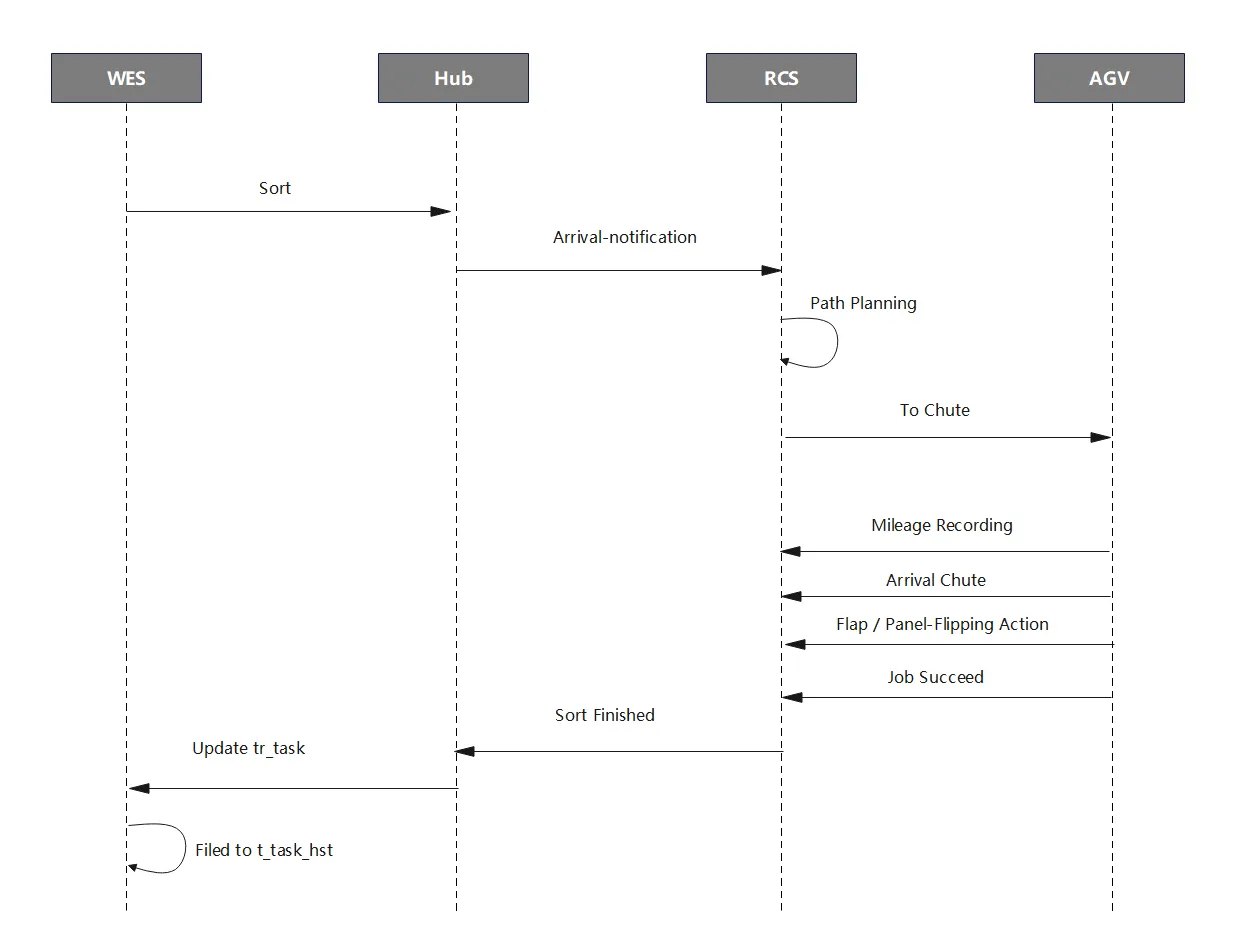
Key Data Closed-Loop (Task Flow)
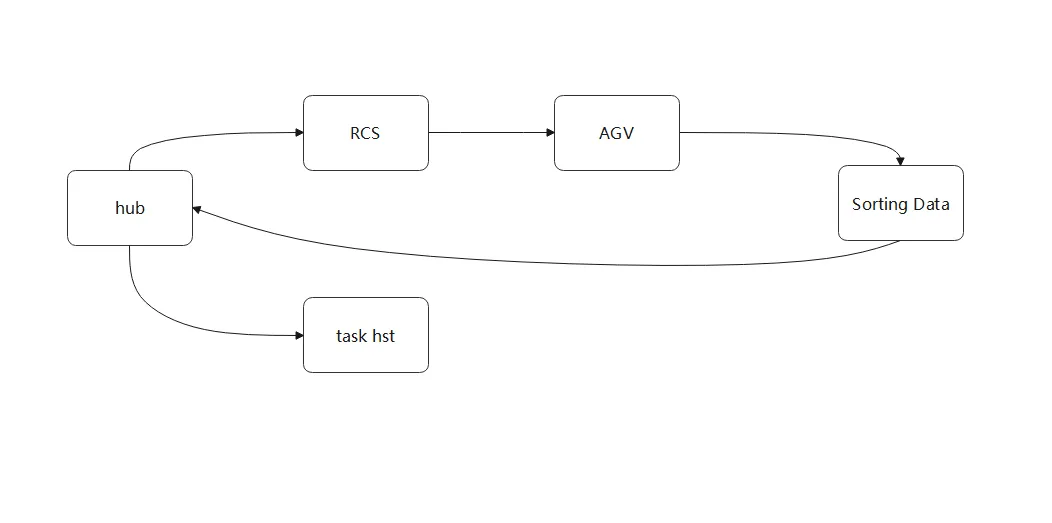
3. Business Themes and Scenario Descriptions
The +A Project mainly focuses on automated sorting, robot operations, and equipment operation monitoring, covering the following business scenarios:
- Task execution-related Cubes (2 in total): Focus on the “full lifecycle of tasks from creation to completion”, including task-level details (Cube_batch_progress_data_details) and batch-level summaries (Cube_batch_progress_data_summary). They cover key fields such as batch_no (batch number), robot_id (robot ID), duration (processing duration), and task_status (task status), supporting quantitative analysis of task efficiency and batch fulfillment.
- Equipment status-related Cubes (5 in total): Focus on the “full lifecycle status of AGV robots”, including charging logs (Cube_wes_db_tsort_charging_log), downtime logs (Cube_wes_db_tsort_downtime_log), driving mileage logs (Cube_wes_db_tsort_odometer_log), power status logs (Cube_wes_db_tsort_power_log), and sorting operation logs.
4. Data Analysis Indicators and Recommendations
The data analysis indicators are systematically organized into four major categories, providing comprehensive monitoring and optimization suggestions for task execution efficiency, equipment energy consumption, fault management, and operational utilization.
Data Analysis Indicators
Batch Task Efficiency
- Total Tasks, Completed Tasks, Abnormal Tasks: Total Tasks refers to the total number of tasks initiated within a certain period; Completed Tasks refers to the number of successfully executed tasks; Abnormal Tasks refers to the number of tasks that failed to complete normally (e.g., timeout, failure). Together, they reflect the overall execution scale and compliance of tasks.
- Average/Median Processing Duration, Maximum/Minimum Processing Duration: Average/Median Processing Duration reflects the general level of task time consumption (the median reduces the impact of outliers); Maximum/Minimum Processing Duration reflects extreme fluctuations in time consumption, which is used to evaluate efficiency stability.
- Robot Utilization Rate: The number of assigned tasks measures the load intensity of robots; the average processing duration measures the processing efficiency of individual robots.
- Abnormal Task Ratio: The ratio of abnormal tasks to total tasks, which directly reflects the stability of task execution.
Charging Behavior and Energy Consumption
- Charging Times, Total Charging Duration, Average Charging Duration per Session: These are used to analyze whether charging efficiency and frequency are reasonable.
- Distribution of Charging Peak Periods: Count the proportion of charging times/duration in each time period to identify periods with concentrated charging demand.
- Charging Anomalies: Record charging events that do not meet expectations (e.g., stopping before full charge, mid-charge interruption).
Downtime and Fault Analysis
- Total Downtime Times, Total Downtime Duration, Average Downtime Duration per Session: These reflect the overall impact scale of downtime and equipment availability.
- Distribution of Downtime Causes: Count the proportion of downtime by cause to identify the main causes of downtime.
- Downtime High-Frequency Periods and Equipment: Identify time periods and equipment with high downtime frequency.
Operating Mileage and Utilization Rate
- Total Driving Mileage, Average Mileage per Equipment: These reflect the overall operation intensity and equipment load balance.
- Equipment Utilization Rate (Operating Duration/Total Available Duration): The ratio of the actual operating duration of equipment to the total available duration (excluding mandatory downtime, etc.), which measures the adequacy of effective work of equipment.
- Utilization Rate Comparison Between Equipment: Conduct horizontal comparison of utilization rates among different equipment to identify inefficient equipment (low utilization rate) or overloaded equipment (high utilization rate), and optimize resource allocation.
Power Management and Anomaly Monitoring
- Power On/Off Times, Abnormal Power Interruption Times: Power On/Off Times reflects the frequency of equipment startup and shutdown; Abnormal Power Interruption Times records unplanned power interruption events, which is used to evaluate the stability of the power system.
- Correlation Analysis Between Power Events and Tasks/Downtime/Charging: Analyze whether power on/off or abnormal power interruption is related to events such as task interruption, equipment downtime, and charging failure, to identify the chain impact of power issues on business.
Sorting Operations and Capacity
- Total Sorting Volume, Sorting Efficiency (Sorting Volume per Unit Time): Total Sorting Volume refers to the number of sorted items completed within a certain period; Sorting Efficiency refers to the sorting volume per unit time (e.g., per hour), which directly reflects the output capacity of the sorting link.
- Sorting Anomalies (e.g., cargo jamming, sorting failure): Count abnormal events during the sorting process (e.g., cargo jamming, sorting to the wrong chute), which is used to evaluate the operation stability of sorting equipment.
- Sorting Peak Periods, Distribution of Sorting Tasks: Identify periods with concentrated sorting volume and task types (e.g., specific chutes/areas) to provide a basis for dynamic adjustment of sorting resources (e.g., robot scheduling, chute maintenance).
Analysis Approach Recommendations
- Multi-dimensional comparison: Compare various indicators by dimensions such as time (daily/weekly/monthly), equipment, robot, and team to identify bottlenecks and anomalies.
- Trend analysis: Focus on the changing trends of key indicators (e.g., task efficiency, downtime duration, charging times) over time to identify potential optimization space.
- Anomaly tracking: Conduct detailed tracking of abnormal tasks, downtime, and charging anomalies to locate problematic equipment or high-frequency periods.
- Correlation analysis: Analyze correlations such as downtime vs. charging, and sorting anomalies vs. equipment status to support operation and maintenance decisions.
- Capacity evaluation: Combine sorting logs and task logs to evaluate the gap between actual capacity and theoretical capacity.
5. Visualization Scheme Examples
The following are specific visualization scheme examples based on the established data analysis indicators:
- 2024 Hourly Task Volume Trend (Cube_batch_progress_data_details)
Indicator: 2024 hourly task units, reflecting the changing trend of tasks per hour over time.
Dimension: start_time (hourly in 2024, formatted as YYYY-MM-DD HH:00:00)
Visualization: Bar Chart or Line Chart, showing the changing trend of tasks per hour over time to intuitively reflect capacity fluctuations in different periods.

2024 Hourly Task Volume Trend – ARobot Project - Daily Total Driving Mileage Trend (Cube_wes_db_tsort_odometer_log)
Indicator: Daily total driving mileage, reflecting the time distribution of the overall operation intensity of robots.
Dimension: record_date (daily in 2024, formatted as YYYY-MM-DD)
Visualization: Line Chart, showing the changing trend of daily total driving mileage to reflect the time distribution of the overall operation intensity of robots.
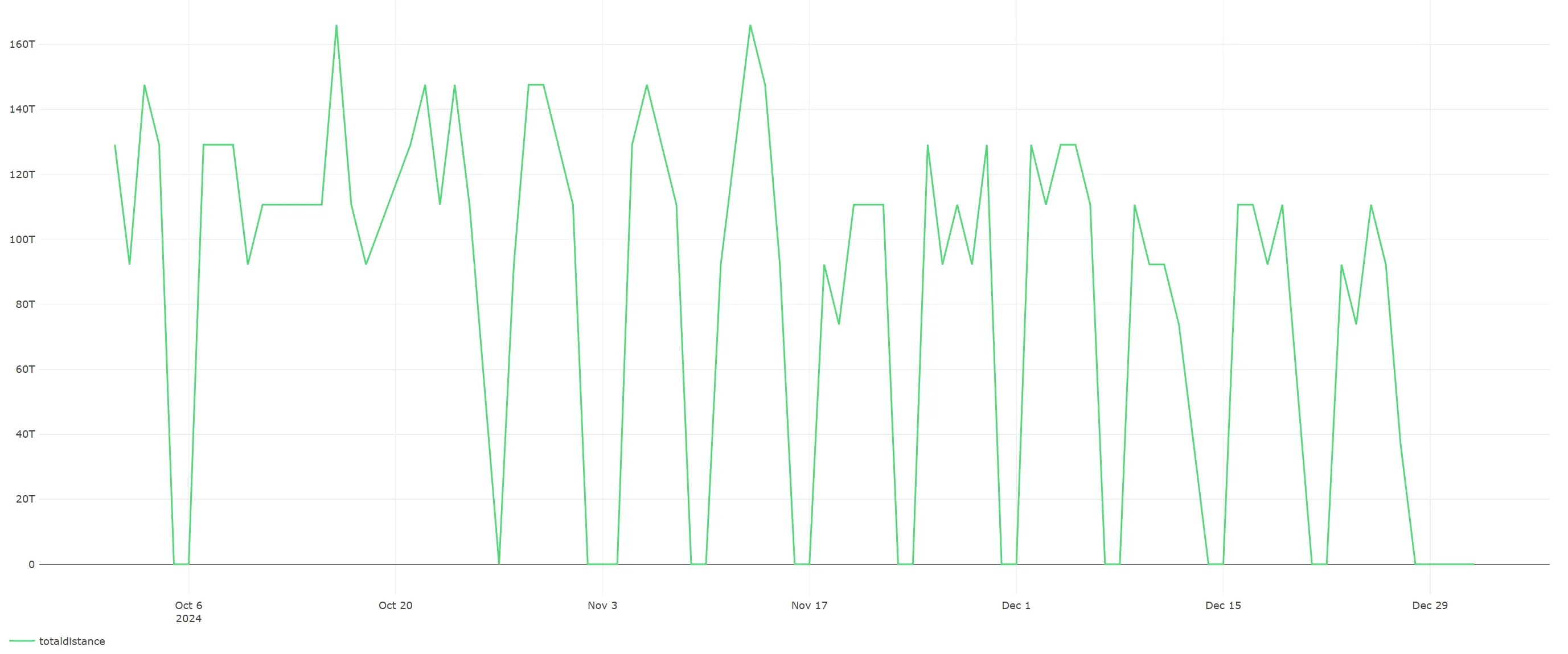
Daily Total Driving Mileage Trend – ARobot Project - Equipment Downtime Analysis (Cube_wes_db_tsort_downtime_log)
Indicator: Downtime duration and proportion by type, reflecting the impact degree of major downtime causes.
Dimension: downtime_type (fault type), record_date (daily)
Visualization: Pie Chart or Stacked Bar Chart, showing the proportional relationship of downtime duration by type to clarify the impact degree of major downtime causes.
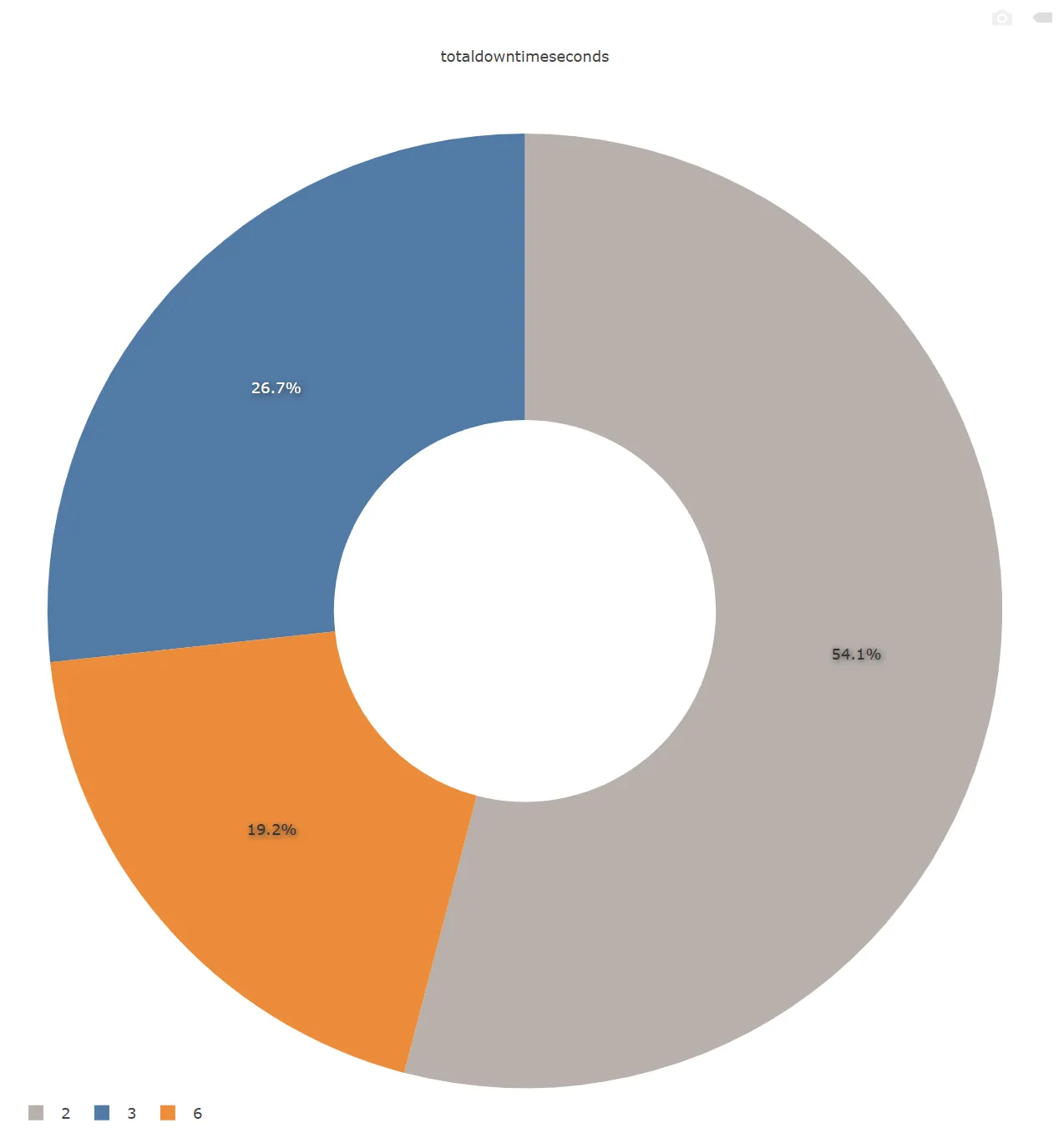
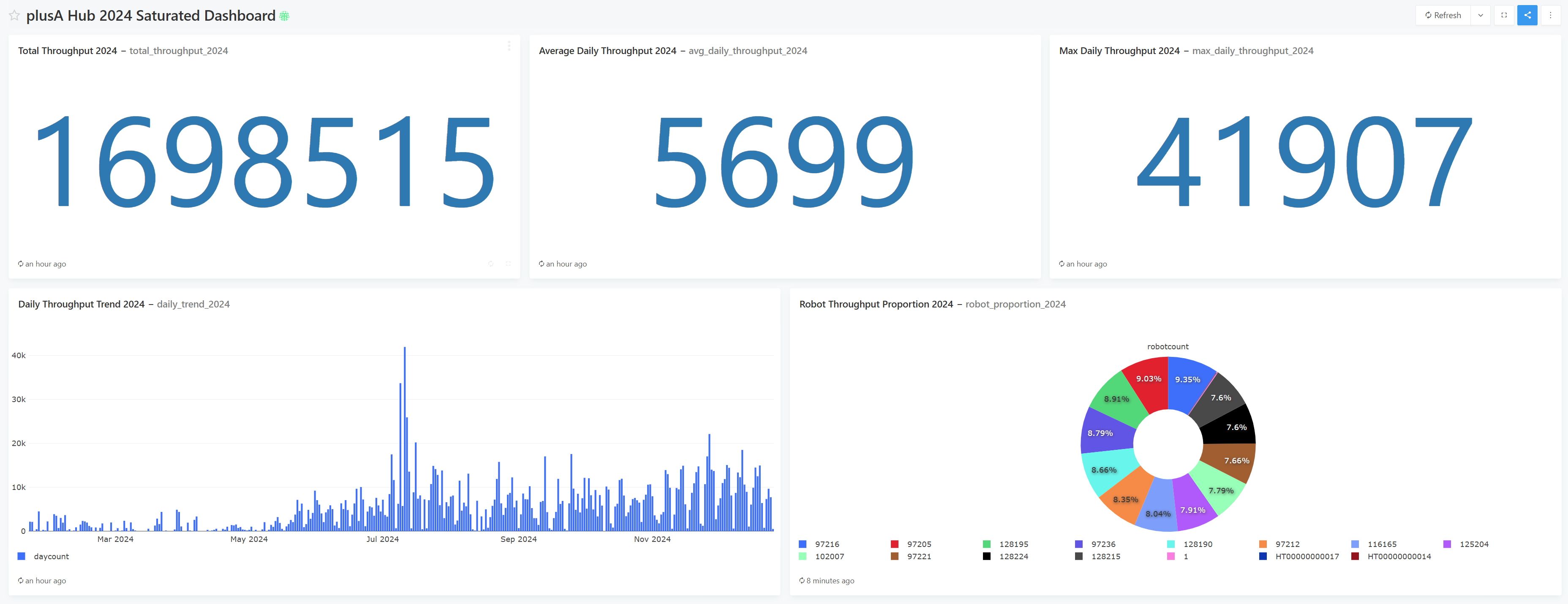
Equipment Downtime Analysis – ARobot Project - Overall Visualization Dashboard
Indicator: Comprehensive display of task volume, fluctuation rules, and robot load distribution.
Dimension: Multiple dimensions (time, robot, task type)
Visualization: Integrated dashboard combining multiple charts.
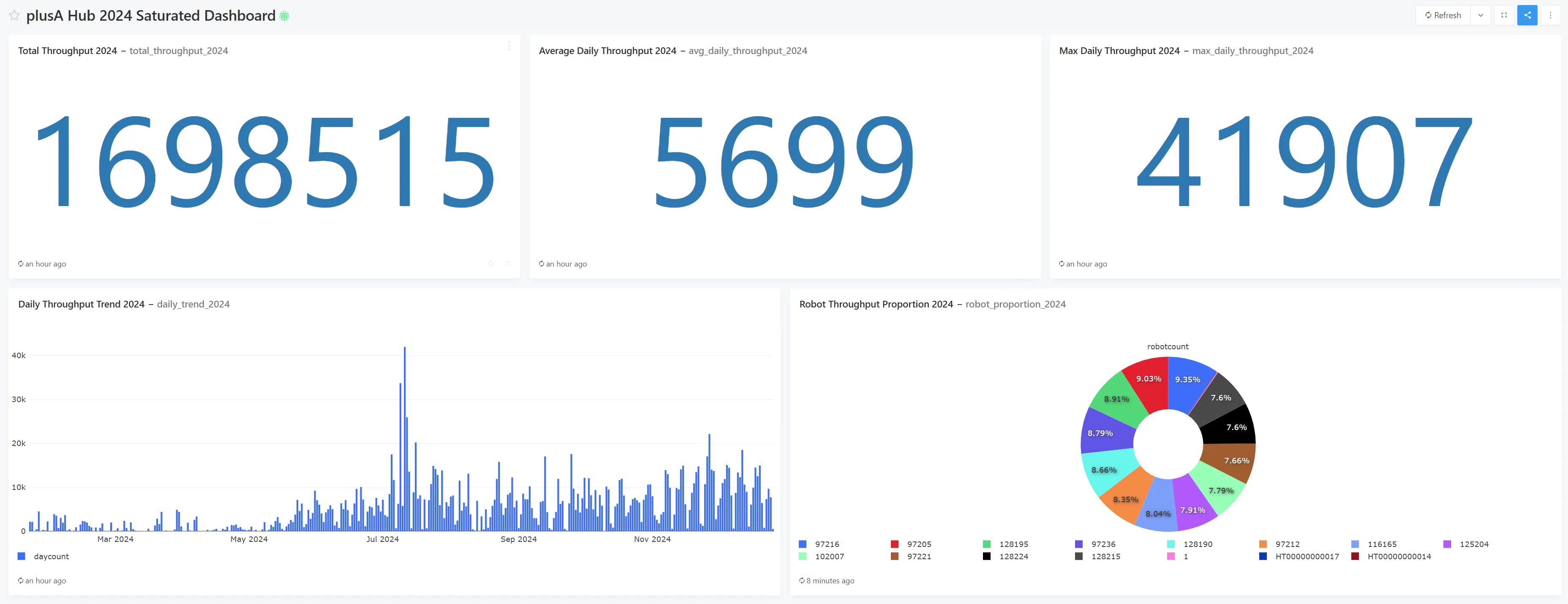
Overall Visualization Dashboard – ARobot Project - 2024 Maximum Daily Task Volume (Cube_batch_progress_data_details)
Indicator: The maximum daily task units and the corresponding date, reflecting the annual peak operation load and its occurrence time.
Dimension: Specific date (a day in 2024, formatted as YYYY-MM-DD)
Visualization: Number Card + Text Annotation - 2024 Daily Volume Trend (Cube_batch_progress_data_details)
Indicator: 2024 daily task units, reflecting the daily fluctuation rules of annual volume.
Dimension: workDay (daily in 2024, formatted as YYYY-MM-DD)
Visualization: Line Chart or Bar Chart - 2024 Task Volume Ratio by Robot (robot_id) (Cube_batch_progress_data_details)
Indicator: 2024 task units of each robot and their percentage of the total volume.
Dimension: robotId (unique robot identifier)
Visualization: Pie Chart or Bar Chart
Check URL to view the dashboard for task contribution ratio” to fully present the annual operation scale, fluctuation rules, and robot load distribution, providing data support for capacity evaluation and resource scheduling.
6. Advanced Analysis and Prediction Approach
To predict the number of “Little Yellow Robots” (AGV robots) required based on workload, the core is to establish a matching model between “workload demand” and “robot effective capacity”.
Step 1: Define Quantitative Indicators for “Workload”
- Total Tasks (T): The total number of tasks to be completed within a unit time.
- Average Processing Time per Task (t): The average time from task assignment to completion for a single task.
Step 2: Determine “Time Window” and “Work Mode”
- Time Window (W): Basic window (e.g., daily working hours) and peak window.
- Work Mode Constraints: Continuous operation or shift-based operation, mandatory downtime for maintenance.
Step 3: Calculate “Effective Capacity per Robot”
The actual capacity of a robot is not simply “Time Window × 100% Utilization Rate”; non-working time (charging, faults, idleness, etc.) must be deducted.
- Effective Operating Duration per Robot per Unit Time (E): Formula: E = Time Window (W) × Effective Utilization Rate (U)
- Task Processing Volume per Robot per Unit Time (P): Formula: P = Effective Operating Duration (E) / Average Processing Time per Task (t)
Step 4: Establish Basic Prediction Model
Basic Formula: Theoretical Number of Robots (N_base) = Total Tasks (T) / Task Processing Volume per Robot per Unit Time (P)
Step 5: Dynamic Adjustment
- Peak Coefficient (K1): Used to cope with short-term workload surges.
- Redundancy Coefficient (K2): Used to cope with uncontrollable factors.
- Adjusted Formula: N_actual = N_base × K1 × K2
Step 6: Verification and Iteration
- Backtesting: Verify with historical data to avoid discrepancies.
- Scenario-Specific Fine-Tuning: Adjust for new warehouses or seasonal fluctuations.
Summary: This approach enables the transition from “passive response” to “proactive planning”, avoiding both resource waste and task delays.
Copyright © 2024 Unis, LLC. All rights reserved.